
Low Temp LiFePo4 Battery Introduction
Battery is becoming one of the most important energy sources in the world. With Li technology development, they also enable electric vehicles to run, contributing to a more sustainable transportation system. Moreover, batteries are essential in many portable electronic gadgets and even in some medical devices.
Low temperature application is always the biggest challenge in the battery field, involves the electrochemistry, battery manage system and battery pack design.
At present, it has two search directions. One is to add the heating system to keep the cells in a nominal working temperature situation. Another is to develop the real low temp electrolyte to inject the cells. The second ones will the most reliable way to solute the lower temperature application, More engineers are researching to keep the balance between the high cost and lower capacity in the real world applications.
Now solemnly introduce Ly-On LiFePo4 26650 series cells. Their advantages are
- A higher discharge rate in the lower temperature environment.
- Still keep the long cycle life.
- Real discharge and charge directly without a software BMS or heating film to heat up.
Cell Specification
|
Model |
Voltage |
Capacity |
IR |
Discharge Rate |
Applied Temp. |
|
IFR26650-LT3500 |
3.2V |
3500mAh |
≤25mΩ |
1C |
Discharge:-40℃~+60℃ |
|
IFR26650-LT3400 |
3400mAh |
≤25mΩ |
3C |
Discharge:-50℃~+60℃ Charge: -30℃~+45℃ |
|
|
IFR26650-LT3200 |
3200mAh |
≤25mΩ |
5C |
||
|
IFR26650-LT3000 |
3000mAh |
≤25mΩ |
10C |
Performance
|
Discharge rate capacity |
Temperature: 25±2℃ Charge: CC/CV to 3.65V at 0.5C current, Ending Current: 0.05C Discharge: CC to 2.0V.
|
|
Cycle Life |
Temperature: 25±2℃ Charge: CC/CV to 3.65V at 0.5C current, Ending Current: 0.05C. Rest time: 0.5h Discharge: CC 0.5C to 2.0V. Rest time: 0.5h
|
|
Discharge Performance at different applied Temperature |
Low Temperature Charge After the discharge of the cell as be discharged to 2.00V at CC 1C under 25±2℃, the nickel sheet spot welding is used to weld the cell, and the test equipment is welded to the nickel sheet with two wires. It is placed in the low temperature environment for 16~24h, and the test point is sealed. After the current of 0.2C is constant current charging to the single cell voltage of 3.65V, it is converted to constant voltage 3.65V charging, and when the charging current is less than 0.05C, the charging stops Low Temperature Discharge After the battery is charged in accordance with be charged to 3.65V with 0.5C,and then, charged continuously with constant voltage of 3.65V until the charged current is 0.05C under 25±2℃, nickel spot welding is used to weld the battery core, and the test equipment is double-wire welded to the nickel sheet, which is placed in the low temperature environment for 16~24h. The test point is sealed, and the current of 1C is constant discharged to the minimum discharge voltage of the single cell. According to the above low temperature test standard, discharge to 1.5V with 1C current
According to the above low temperature test standard, discharge to 2.0V with 1C current
After charging as be charged to 3.65V with 0.5C, continuously to 3.65V until the charged current is 0.05C under 25±2℃ , discharge at constant current of 1C to 2.0V
|




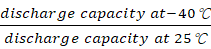
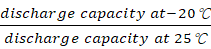
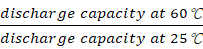
Test condition
- Charge fully CC/CV at 0.5C under 25℃
- Rest 6h under -40℃/-30℃/-20℃/0℃/25℃/45℃. The relative test port does well the sealing.
- Discharge to 2.0V/1.5V at 0.5C
Application:
Cold Chain Warehouse AGV
Snow Sports Equipment
Polar expedition
Welcome to contact us to get more information.Robotic lawnmower battery
Warranty and Liabilities
Related Article
